Plug-in Solar Panels in the UK: Rules, Costs and Real Output in Manchester
Key takeaways
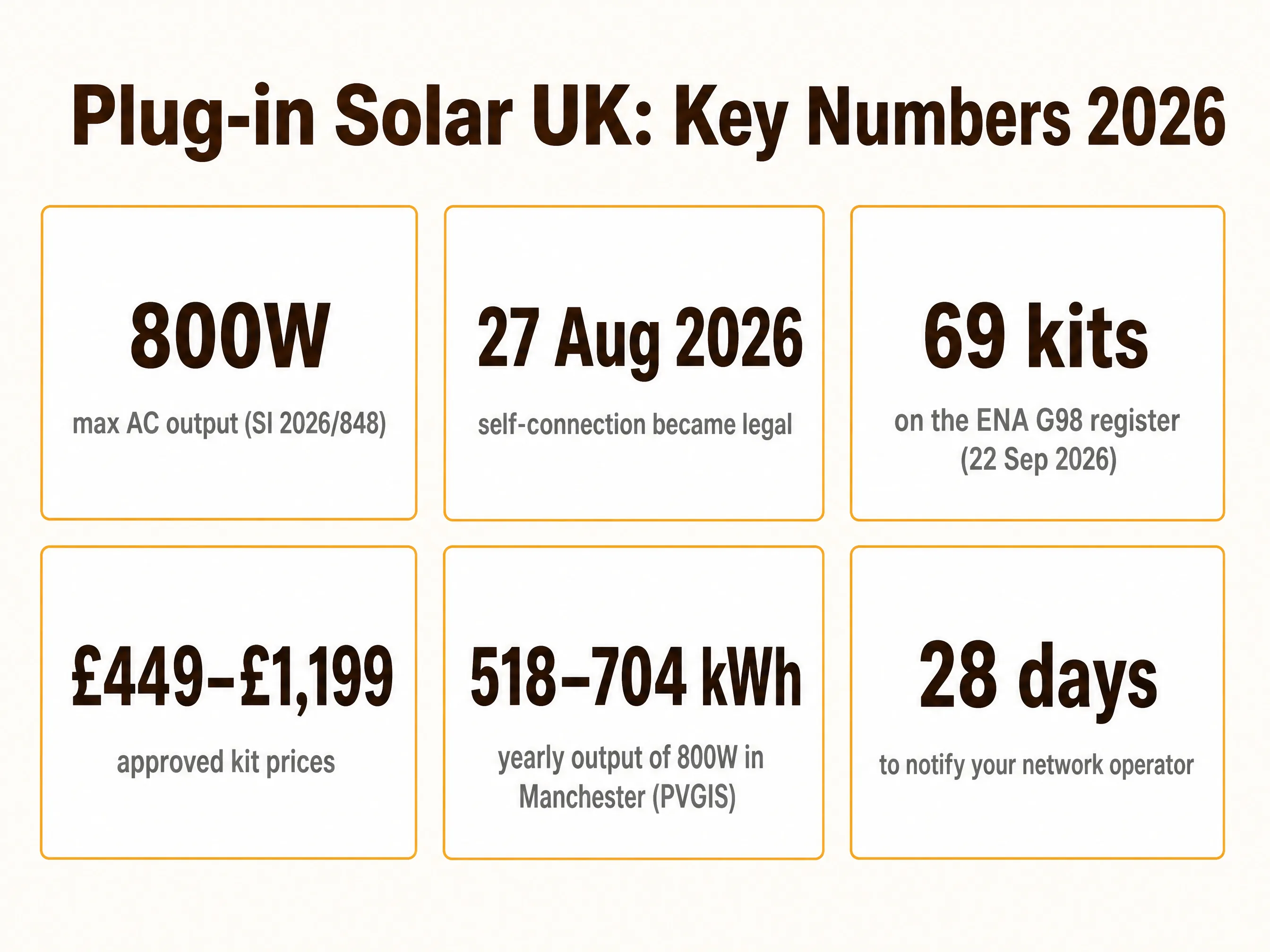
- The legal limit is 800W of AC output per device, set by SI 2026/848, in force from 27 August 2026.
- Only kits listed on the ENA G98 Type Test Register can be self-connected: 69 kits from 19 manufacturers as of 22 September 2026.
- Approved kits cost £449–£1,199, with most between £650 and £750 (Plug Solar Hub).
- In Manchester, an 800W kit produces about 518 kWh a year hung vertically and 704 kWh at a 30° tilt (our PVGIS modelling).
- Using 80% of that at home at 26.32p/kWh saves roughly £109–£148 a year, so a £650 kit pays back in about 4.4–6.0 years.
- The government's safety study found plug-in solar worked safely on typical UK ring circuits, but five electrical bodies still urge stronger product standards.
What are plug-in solar panels?
Plug-in solar panels are small kits, usually one or two panels and a microinverter, that plug straight into an ordinary 13A wall socket. They're also called balcony solar. The electricity they make flows into your home's wiring and is used first by whatever is running at the time, such as the fridge, router or washing machine.
They're designed to trim daytime use, not to replace a roof system. As Kian Milroy, an MCS-nominated renewables electrical engineer, told Heatable: "these panels are not designed to power an entire home. They are designed to nibble away at your daytime electricity use."
Germany proved the model first. The UK government noted about 426,269 balcony solar registrations in Germany in 2025 alone, which is part of why ministers moved to allow them here.
Are plug-in solar panels legal in the UK now?
Yes. The Plugs and Sockets etc. (Safety) Regulations 1994 and Electricity Safety, Quality and Continuity Regulations 2002 (Amendment) Regulations 2026 (SI 2026/848) were made on 16 July 2026 and came into force on 27 August 2026. They define a plug-in microgenerator as a solar device with a maximum rated AC output of no more than 800 watts, connected by a standard plug and socket.
The plug must meet the Plug-in Solar Device Interim Product Specification (version 2, published 16 July 2026). In practice that means you can only self-connect complete products that appear on the ENA G98 Type Test Register. A kit being sold in the UK is not proof that it's approved.
Two details catch people out. The ESQCR change covers England, Wales and Scotland only, as Northern Ireland has its own rules. And while the specification allows one device per circuit, the G98 notification rule still assumes one kit per household until it is amended.
How much electricity do plug-in solar panels generate in Manchester?
An 800W plug-in kit in Greater Manchester produces roughly 500–740 kWh a year, depending mainly on its angle. We modelled 800W of south-facing panels with PVGIS (14% system losses) at three mounting angles in three boroughs:
| Mounting | Manchester | Wigan | Oldham |
|---|---|---|---|
| Vertical balcony (90°) | 518 | 546 | 502 |
| Railing/wall at 60° | 677 | 715 | 659 |
| Ground frame at 30° | 704 | 740 | 687 |
Tilt matters more than location. Hanging panels flat against a balcony rail costs about a quarter of the output compared with a 30° frame. Wigan, in the flatter west of the county, beats Oldham on the Pennine side by about 8%. See how your area compares on our Greater Manchester borough comparison.
A typical UK home uses 2,700–3,000 kWh a year (Heatable), so a plug-in kit covers roughly a fifth of it. That share is only realistic if someone is home, or appliances run, during daylight.
How much do plug-in solar panels cost and save?
Approved kits cost £449–£1,199, and most sit around £650–£750 (Plug Solar Hub register tracker). Because the output is small, most of it gets used in the home rather than exported, so we assume 80% self-use.
At the October–December 2026 price cap unit rate of 26.32p/kWh, that saves about £109 a year for a vertical balcony kit in Manchester and about £148 for one at 30°. On a £650 kit, that means a payback of roughly 4.4–6.0 years. The government's own estimate is more cautious, at £70–£110 a year.
Don't count on export income. Most Smart Export Guarantee tariffs require MCS certification, which plug-in kits don't have, so any surplus you send to the grid is usually unpaid. Compare the numbers against a full roof system with our solar payback calculator.
How do plug-in solar panels compare with rooftop solar?
Plug-in solar is cheaper and needs no installer. A rooftop system produces around five to seven times as much electricity and qualifies for export payments. Here's how the two compare in Manchester:
| Plug-in kit (800W) | Rooftop system (4kWp) | |
|---|---|---|
| Yearly output (Manchester) | 518–704 kWh | about 3,552 kWh |
| Typical cost | £449–£1,199 | £6,260–£7,140 |
| Who installs it | You, into a wall socket | MCS-certified installer |
| Grid notification | You send G98 within 28 days | Installer handles it |
| Export payments (SEG) | Usually not eligible | Eligible |
| Suits | Flats, renters, small budgets | Homeowners with a usable roof |
Rooftop figures use MCS cost data (£1,565–£1,785 per kWp) and PVGIS yield for Manchester. For details, see our guides to solar panel costs in Manchester and solar panels in Manchester.
Are plug-in solar panels safe?
The government's evidence says yes, with conditions. A 96-page DESNZ study by Arceio, published on 16 June 2026, tested plug-in systems on typical UK domestic circuits. It found anti-islanding shut the systems down when grid power was removed, protective devices tripped correctly, and there was no overheating. It also found performance varied between products, including some conducted-emissions failures, and recommended a UK qualifying product standard.
The electrical industry is more cautious. In a joint statement on 9 June 2026, the ECA, Electrical Safety First, the IET, NICEIC and SELECT warned about older wiring, unsafe imports, unclear insurance cover and misuse such as extension leads. Their message was that "safety must not be an afterthought".
The practical takeaway is simple. Buy only from the G98 register, plug into a fixed wall socket, keep to one kit, and tell your home insurer.
How do you connect plug-in solar panels legally?
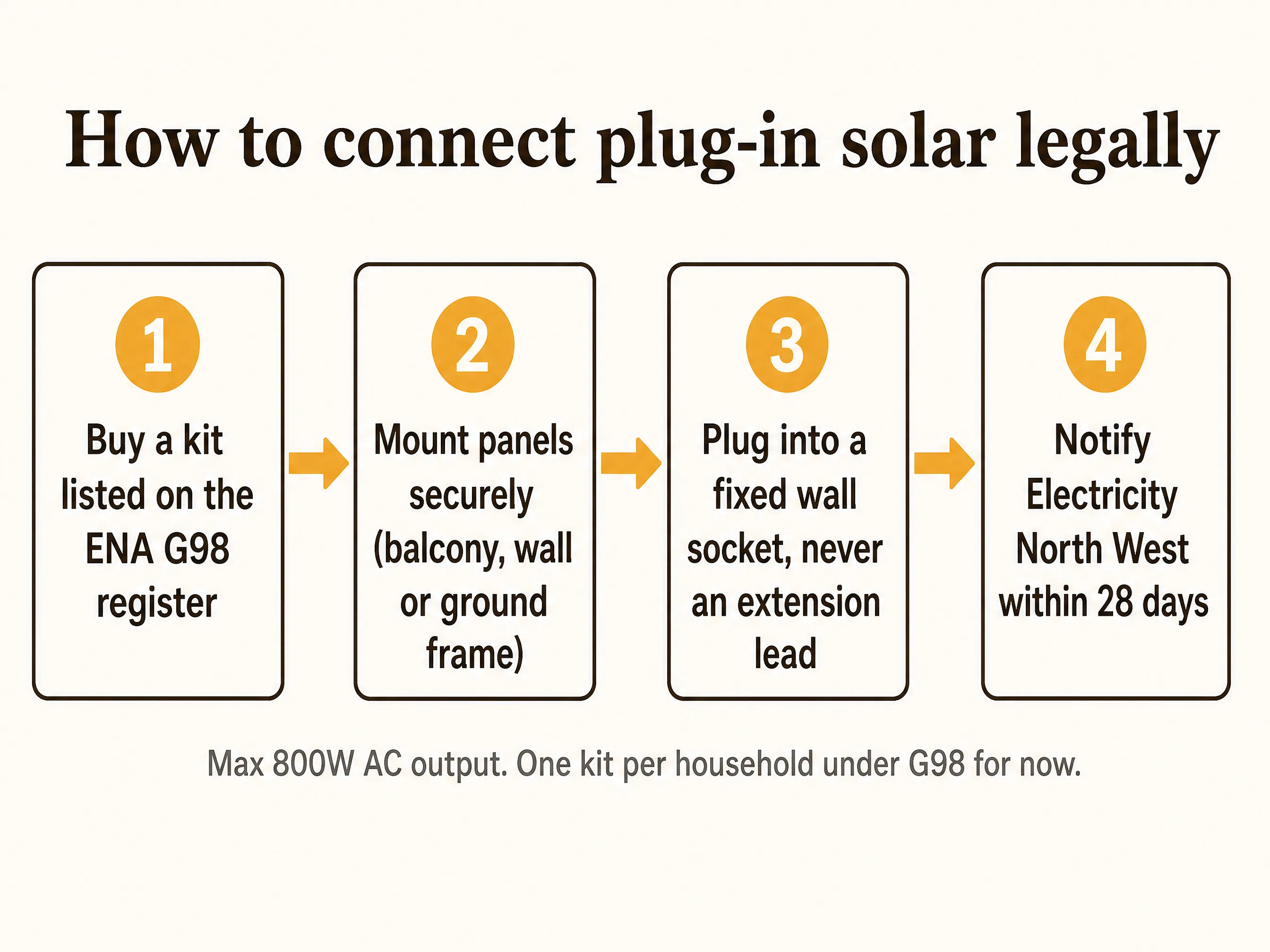
There are four steps. First, check the exact model code against the ENA G98 Type Test Register; approval sits with the model, not the brand. Second, fix the panels securely to a balcony rail, wall or ground frame. Third, plug the kit into a fixed BS 1363 wall socket, never an extension lead or adapter.
Fourth, send a G98 notification to your network operator within 28 days of first switching it on. In Greater Manchester that is Electricity North West. The form is free and asks for your address, MPAN (from your bill), the inverter model and the 800W rating. Keep the acknowledgement for your insurer and for when you sell the property.
Who should buy plug-in solar in Greater Manchester?
Plug-in solar makes most sense for people who can't fit rooftop panels: flat owners in Salford Quays or Manchester city centre, renters (with the landlord's permission), and anyone with a south-facing balcony or garden who is home in the day. Salford readers can see local figures on our Salford solar page.
If you own a house with a usable roof, a full system usually gives better value per pound over its lifetime, with export payments and grants in Greater Manchester on top. You can later add a home battery to store the midday surplus. For a quote on either, get in touch.
Have a roof as well as a balcony?
A 4kWp roof system in Manchester makes about 3,552 kWh a year.
Plug-in solar panels: FAQs
Do I need an electrician to install plug-in solar?
No. If the kit is listed on the ENA G98 Type Test Register and plugs straight into a fixed wall socket, you can connect it yourself. You still have to notify your network operator within 28 days.
What is the maximum size of plug-in solar allowed in the UK?
800W of AC output per device, as set by SI 2026/848. Kits can have up to about 2,000W of panels behind the microinverter, but the output to your socket is capped at 800W.
Can I use plug-in solar in a rented flat?
The law allows it, but you need your landlord's permission to fix panels to a balcony, wall or railing. Leases often restrict changes to the outside of a building.
How much electricity does an 800W plug-in solar kit produce in Manchester?
About 518 kWh a year hung vertically on a south-facing balcony, rising to about 704 kWh at a 30° tilt. Those figures come from PVGIS data for south-facing panels.
Does plug-in solar get paid for exported electricity?
Usually not. Most Smart Export Guarantee tariffs require MCS certification, which plug-in kits don't have, so surplus export is normally unpaid. That's why the savings come from using the power yourself.
Can I plug solar panels into an extension lead?
No. The rules require a direct connection to a fixed BS 1363 wall socket. Extension leads and adapters are one of the main risks electrical safety bodies have warned about.
Who do I notify about plug-in solar in Greater Manchester?
Electricity North West, the region's network operator. The G98 notification is free and must be sent within 28 days of first connecting the kit.
Is plug-in solar legal in Northern Ireland?
The plug approval change covers the whole UK, but the ESQCR amendment in SI 2026/848 applies only to England, Wales and Scotland. Northern Ireland has separate rules, so check with NIE Networks.
Methodology
Sources
- SI 2026/848 (legislation.gov.uk)
- GOV.UK: plug-in solar available within months (24 Mar 2026)
- DESNZ plug-in solar PV safety study by Arceio (16 Jun 2026, PDF)
- Joint statement: ECA, Electrical Safety First, IET, NICEIC, SELECT (9 Jun 2026)
- Plug Solar Hub: ENA G98 Type Test Register tracker (22 Sep 2026)
- Heatable: plug-in solar panels (updated 24 Aug 2026)
- Ofgem price cap, 1 Oct – 31 Dec 2026
- EU JRC PVGIS v5.2
- Pluggedin.solar: G98 notification guide
- Fuse Energy: plug-in solar legislation
- The Eco Experts: solar panel cost (MCS data)