Buying a House With Solar Panels and Battery: What Are They Worth, and What Should You Pay?

Key takeaways
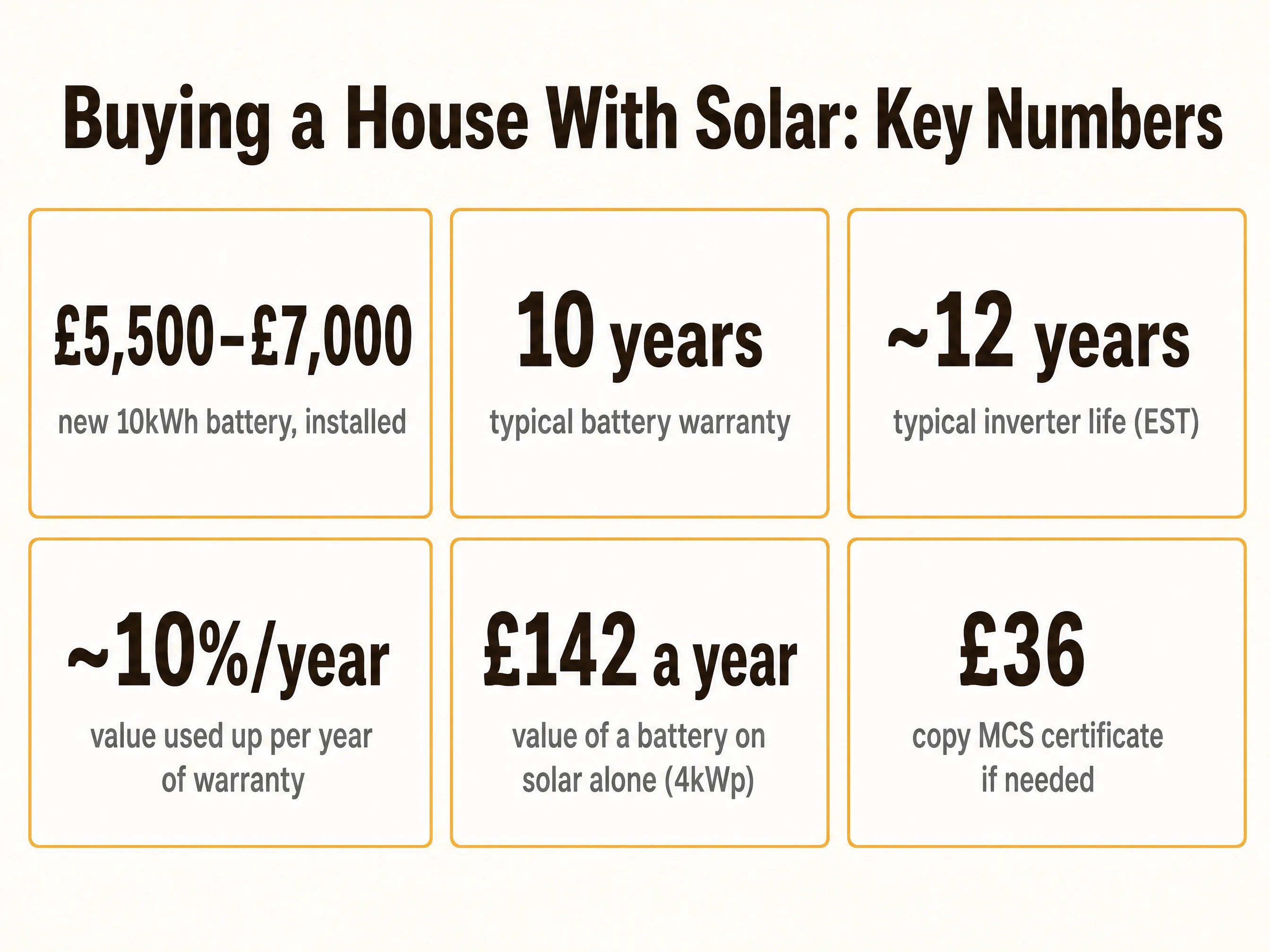
- A new 10kWh battery costs £5,500–£7,000 installed, and most carry a 10-year warranty, so a 4-year-old one has used about 40% of its warranted life.
- Inverters generally need replacing after about 12 years, according to the Energy Saving Trust.
- Panels can't generate without an inverter, so a seller who removes the inverter leaves the roof panels useless and must pay an electrician to make the system safe.
- If the house gets Feed-in Tariff payments, they can pass to you: the seller tells the FIT company and you provide evidence of the change of ownership.
- Ask for the MCS certificate, FIT or SEG contracts, warranties and manuals; the Energy Saving Trust’s buyer checklist covers these.
- Buyers on r/SolarUK were asked £5,000 for a 2022 set of batteries and inverters; replies suggested offering far less.
Why would a seller charge extra for solar panels and batteries?
Because panels are usually treated as part of the house, but batteries and inverters sit indoors and can be listed as excluded items on the fittings and contents form. Some sellers use that to recover part of what they paid, or plan to take the battery to their next home.
It's a common problem. One r/SolarUK buyer was told the inverters and batteries had been listed as exclusions from the start, with the seller asking £5,000 for them; another was offered a seller’s batteries and inverter “at cost”. Both threads drew around 100 replies, mostly urging buyers not to pay the asking price.
How much is a used solar battery and inverter worth?
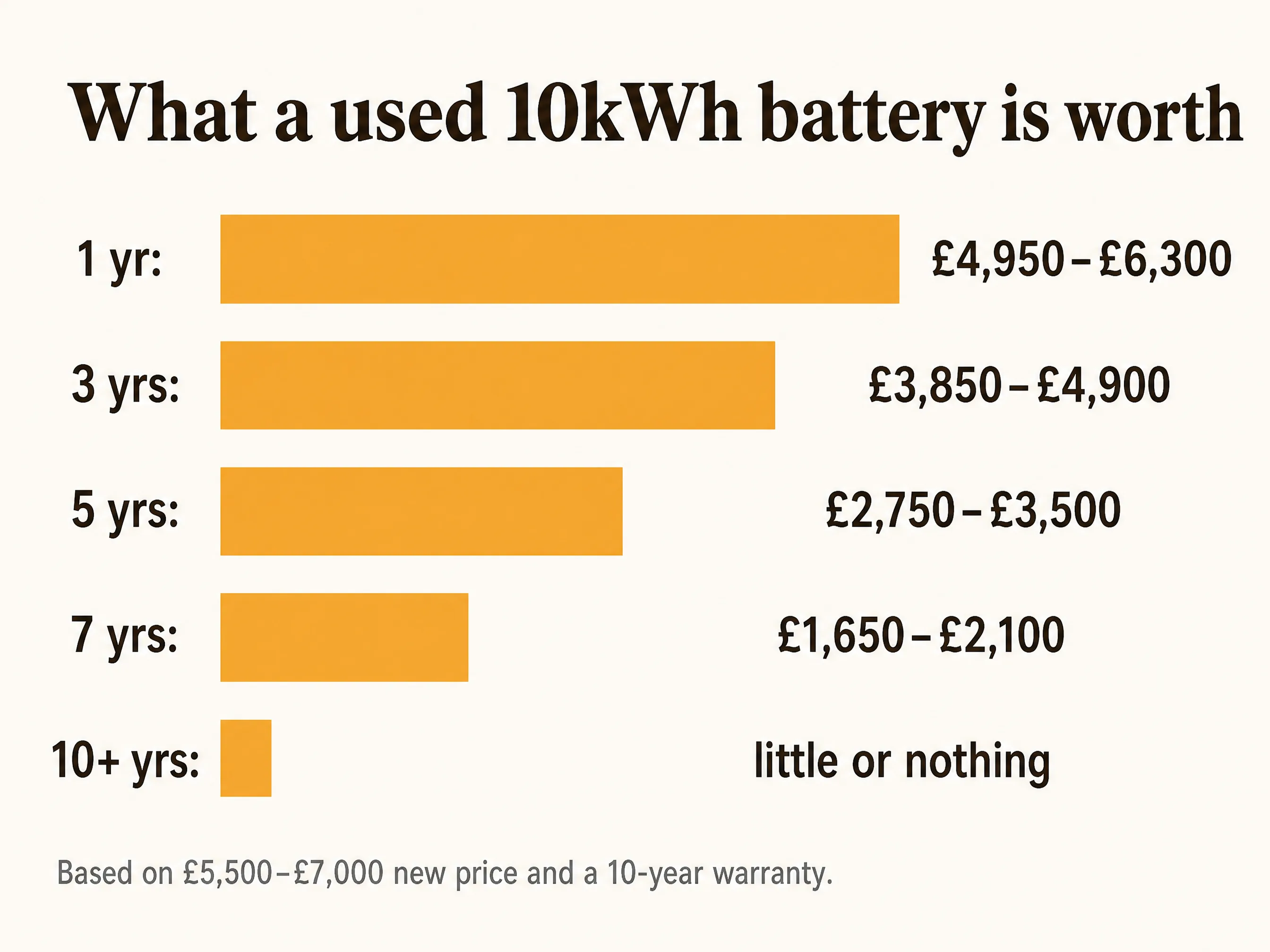
Use the replacement cost as a ceiling and knock off value for age. Most batteries carry a 10-year warranty, so a straight-line approach takes about 10% off per year:
| Battery age | Warranty life left | Ceiling value | What to consider |
|---|---|---|---|
| 1 year | 90% | £4,950–£6,300 | Check the warranty transfers to you |
| 2 years | 80% | £4,400–£5,600 | Ask for the installer's details |
| 3 years | 70% | £3,850–£4,900 | Check the manufacturer is still trading |
| 4 years | 60% | £3,300–£4,200 | Inverter may need replacing within 8 years |
| 5 years | 50% | £2,750–£3,500 | Get a health check of capacity |
| 7 years | 30% | £1,650–£2,100 | Budget for inverter replacement |
| 10+ years | 0% | Little or nothing | Out of warranty |
The ceiling assumes the battery would cost the same to buy new. Treat it as a maximum: a second-hand system usually sells for less because you get no new installer warranty. New prices come from Heatable (June 2026); for today's full costs see our solar battery guide.
What is a used battery worth to you in savings?
Less than most sellers think, unless you use a time-of-use tariff. On a 4kWp system in Manchester, storing spare solar for the evening is worth about £142 a year on our figures. Over the 6 years left on a 4-year-old battery's warranty, that's about £850.
With a cheap overnight tariff or a peak-export tariff the value rises, which is why the right tariff matters. Model it in our solar payback calculator. Your offer should sit somewhere between the savings value and the replacement-cost ceiling.
What happens if the seller removes the inverter and battery?
The panels stop working. Solar panels produce DC power that has to go through an inverter, and many battery systems use a hybrid inverter that runs both. Take it out and the panels on the roof produce nothing usable.
The seller would also have to pay a qualified installer to disconnect and make the system safe, which they can't recover. That gives you real negotiating leverage: removing the kit costs them money, while leaving it with you costs them nothing.
What documents should you ask for when buying a house with solar panels and battery?
The Energy Saving Trust lists the MCS certificate, ownership and transfer forms, any Feed-in Tariff or Smart Export Guarantee contracts, warranties (typically 25 years for panel performance and 5–10 years for products), user manuals and insurance documents. Your solicitor can help with the ownership and transfer forms.
Also ask for the DNO notification (G98 or G99) and the installer's name. If the MCS certificate is missing and the installer has gone, MCS can issue a copy; see what to do if a solar company has gone bust. If the panels are leased from a rent-a-roof company, get the lease checked by your solicitor before exchange.
Do Feed-in Tariff payments transfer to the new owner?
Yes. If the property earns Feed-in Tariff payments (from systems registered before the scheme closed to new applicants in 2019), they can pass to you. The previous owner must tell the FIT company, and the new owner provides evidence of the change in ownership, such as the sale and purchase agreement.
If the FIT company handles it badly, you can escalate to the Energy Ombudsman. FIT income makes a system worth more to a buyer, so check the contract terms and remaining years before agreeing a price.
How should you negotiate over a seller's solar system?
Start from the savings value, not the seller's purchase price. Point out the age, the remaining warranty, any inverter replacement due, and that removing the kit would cost them an installer's fee and leave the panels useless.
Ask for a health check before exchange: a local MCS installer can test battery capacity, inverter logs and generation. Compare the system's output with the expected yield for the area on the Greater Manchester borough comparison, and use our solar panel cost guide to see what new kit would cost. For a pre-purchase system check, get in touch.
Buying a house with solar?
Get the system checked before exchange so you know what it's really worth.
House with solar panels and battery: FAQs
Can a seller take the solar battery when they sell the house?
Yes, if it's listed as an excluded item on the fittings and contents form. Panels are usually treated as part of the property, but batteries and inverters can be excluded.
How much should I pay for a used solar battery?
At most its replacement cost minus about 10% per year of age, since most batteries have a 10-year warranty. A 4-year-old 10kWh battery has a ceiling of around £3,300–£4,200, and a fair price is often lower.
Do solar panels work without the inverter?
No. Panels need an inverter to convert their power for your home. If the seller removes it, the panels produce nothing usable.
Do Feed-in Tariff payments transfer when you buy a house?
Yes. The seller must tell the FIT company, and the new owner provides evidence of the change in ownership, such as the sale and purchase agreement.
What documents should I get when buying a house with solar panels?
The MCS certificate, FIT or SEG contracts, warranties, user manuals, insurance details, the DNO notification and the installer's name.
Does a solar battery warranty transfer to a new owner?
It depends on the manufacturer. Check the warranty terms and whether you need to register as the new owner.
Is a solar battery worth buying from a house seller?
Often, if the price reflects its age. Storing spare solar alone is worth about £140 a year on a 4kWp system in Manchester, more with a time-of-use tariff.
Methodology
Sources
- Heatable: home battery storage costs (updated 9 Jun 2026)
- Energy Saving Trust: buying a house with solar panels (13 Aug 2026)
- Energy Ombudsman: Feed-in Tariffs
- r/SolarUK: house seller wants us to buy the inverters and batteries
- r/SolarUK: house seller offering batteries and inverter at cost
- Ofgem price cap, 1 Oct – 31 Dec 2026
- EU JRC PVGIS v5.2
- MCS: certificate queries