Solar Company Gone Bust? What Happens to Your Warranty, Paperwork and Export Payments

Key takeaways
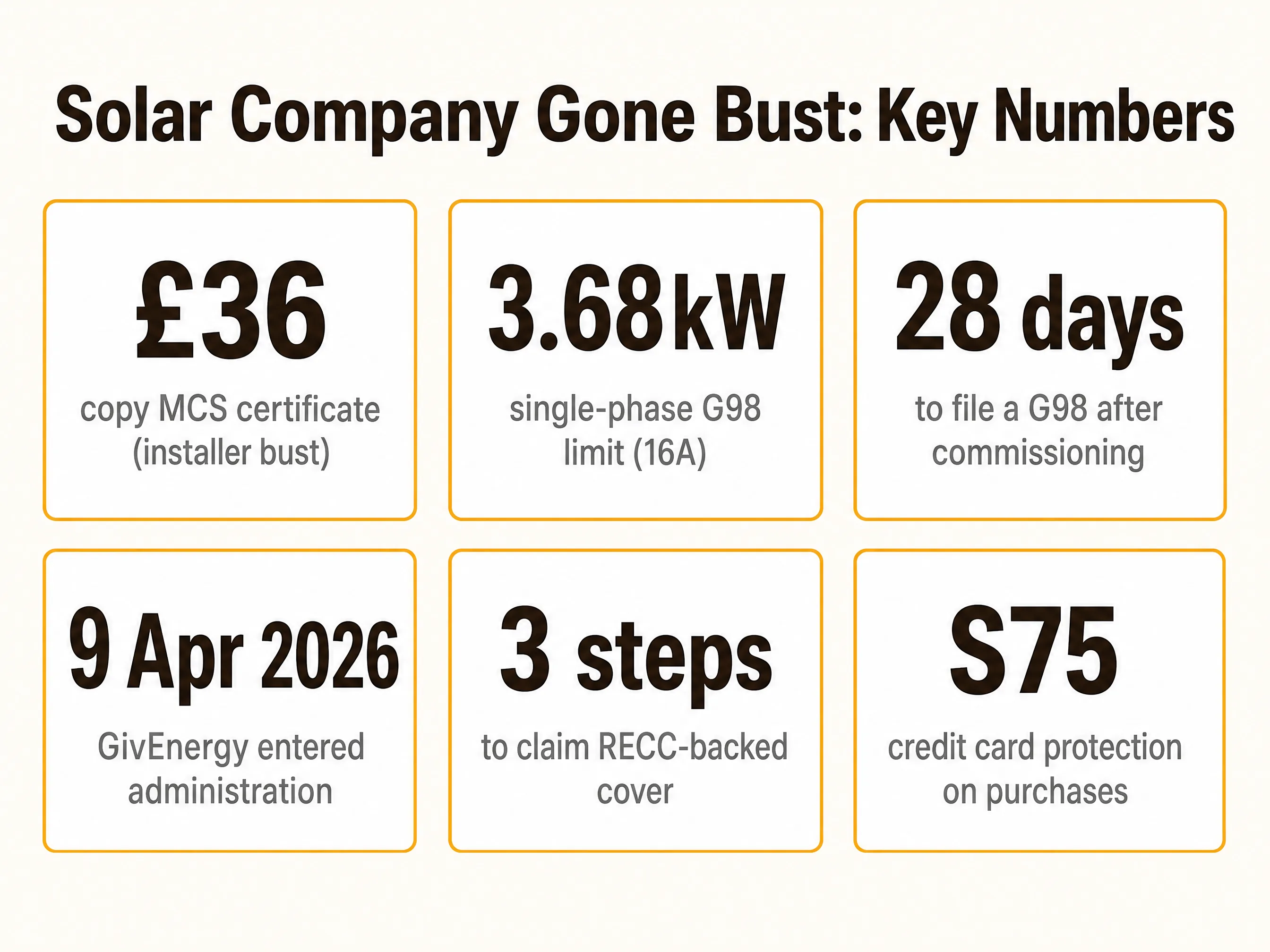
- RECC members must insure deposits, stage payments and workmanship warranties, so you claim from the insurer, not the failed company.
- MCS can issue a copy certificate for £30 + VAT (£36) if your installer is no longer trading, but it can't create one that was never registered.
- Systems up to 16A per phase (3.68kW single-phase) only need a G98 notification within 28 days; larger ones needed G99 approval before connection.
- GivEnergy entered administration on 9 April 2026, and its hardware warranties are no longer being honoured.
- GivEnergy's app runs through a separate company, GivEnergy Software Ltd, which is not in administration.
- If you paid by credit card, Section 75 of the Consumer Credit Act may let you claim from the card provider.
What happens to your solar panels if the company goes bust?
Physically, nothing. Your panels, inverter and battery keep generating, and your savings on electricity bills continue. What you lose is the installer: their workmanship warranty, their help with faults, and sometimes paperwork they should have filed but didn't.
Manufacturer warranties on panels and inverters are separate from the installer, so they usually survive. The exception is when the manufacturer itself fails, as GivEnergy did in 2026.
What should you do first if your solar installer goes bust?
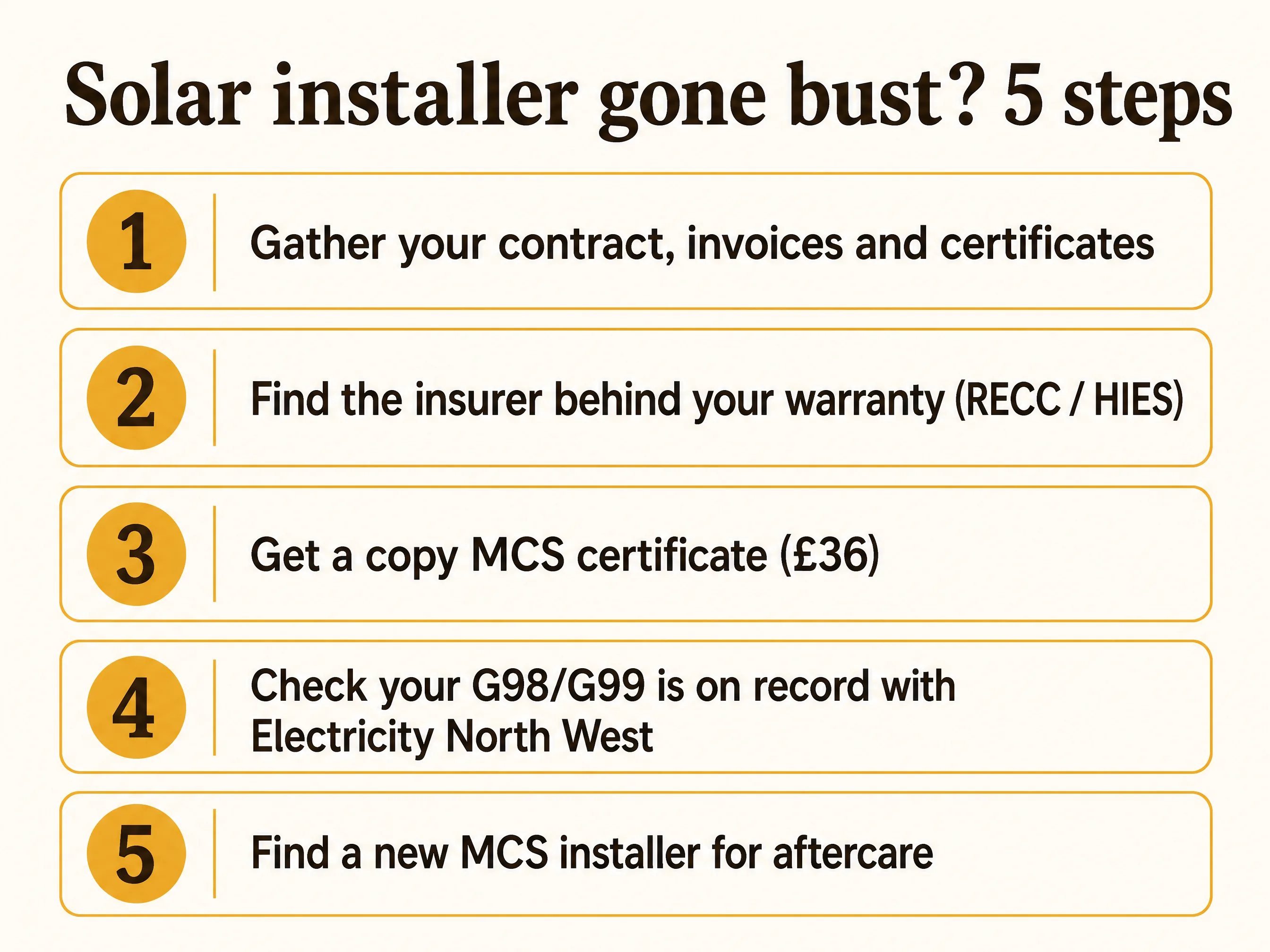
Work through five steps in this order:
| Step | What to do | Why it matters |
|---|---|---|
| 1. Gather paperwork | Contract, invoices, MCS certificate, warranty documents, DNO emails | You'll need them for every claim |
| 2. Find the insurer | Check your paperwork or MCS certificate, or ask RECC or HIES | Deposits and workmanship are claimed from the insurer |
| 3. Get your MCS certificate | Ask MCS for a copy (£36) if you never had one | Needed for export (SEG) payments and resale |
| 4. Check the DNO notification | Ask Electricity North West whether a G98 or G99 is on record | Export can't start without it |
| 5. Find a new installer for aftercare | Use an MCS-certified firm | Manufacturer claims usually need an installer to diagnose and swap parts |
If the work was grant-funded, TrustMark may be responsible for aftercare; it has set up a dedicated page for Consumer Energy Solutions customers, one of the larger grant installers to fail.
How do you claim on a solar workmanship warranty after the installer has gone bust?
Through the insurance backing it, if the installer was a member of a consumer code. RECC requires members to “insure any deposits and further advance (or ’stage’) payments they take, together with the workmanship warranties they issue”.
RECC's claim process has three steps: identify the insurer from your paperwork or MCS certificate (or by contacting RECC), contact that insurer, and follow its claims process. Outcomes vary; some insurers refund deposits and others find a new contractor to finish or fix the work.
Before you sign with any installer, check this cover exists. Our solar quote guide explains what else to check in a quote.
How do you replace a missing MCS certificate?
Ask MCS directly. If your installer is no longer MCS-certified or no longer trading, MCS can generate the certificate on the installer’s behalf for £30 + VAT (£36), with proof of address. You can check whether one exists by calling the MCS helpdesk on 0333 103 8130.
If the installation was never registered, MCS says it “is unable to help in raising a new certificate”. Without one you can't claim most Smart Export Guarantee tariffs, so you may need a new MCS installer to inspect and re-certify the system.
What if your installer never filed the G98 or G99?
You'll find out when your supplier refuses to start export payments. Systems up to 16A per phase, or 3.68kW on a single-phase supply, only need a G98 notification within 28 days of commissioning. Anything larger needed G99 approval before connection.
In Greater Manchester the network operator is Electricity North West. Ask it whether a notification is on record for your address. If not, a new MCS installer or electrician can submit a retrospective one; for a larger G99 system the DNO may want technical details or an inspection first.
What happens to GivEnergy batteries after the administration?
They keep working, but warranty support has gone. GivEnergy entered administration on 9 April 2026, with Christopher Brooksbank of CB Business Recovery appointed as administrator, and hardware warranties are no longer being honoured.
The app is separate. The UK Energy Storage Association, whose chief executive Jason Howlett previously led GivEnergy, said: “As GivEnergy’s app and portal are managed by GivEnergy Software Ltd (which is not in administration), there is no impact currently expected to your app and portal experience.” GivEnergy has consulted on charging for remote app access, so that may change.
Contact your installer first about faults. If you paid by credit card, a Section 75 claim may be possible. If your battery needs replacing, see our solar battery guide for current prices.
How can you protect yourself before you choose an installer?
Check that the installer is MCS-certified and a RECC or HIES member, and that your deposit and workmanship warranty are insured. Pay deposits by credit card where you can. Avoid large upfront payments; deposits are best kept small until the kit is on site.
Get at least two quotes and compare price per kWp with the benchmark in our solar panel cost guide. Check whether you qualify for funding in our grants guide, and see how national brands compare in Octopus vs a local installer. For help with an orphaned system, get in touch.
Left with an orphaned system?
We can check your system, paperwork and export set-up.
Solar company gone bust: FAQs
Does my solar warranty still apply if the installer goes bust?
The manufacturer's warranties on panels and inverters usually still apply. The installer's workmanship warranty is only protected if it was insured, which RECC requires of its members.
How do I get my deposit back from a solar company that went bust?
Claim from the insurer that covered the deposit. RECC members must insure deposits and stage payments; find the insurer in your paperwork or ask RECC. If you paid by credit card, you may also have a Section 75 claim.
How do I get a copy of my MCS certificate?
Contact MCS. If your installer is no longer trading, MCS can issue a copy for £30 + VAT (£36) with proof of address. It can't create a certificate that was never registered.
Can I get export payments if my installer never registered the system?
Not usually. Most SEG tariffs need an MCS certificate and DNO notification. A new MCS installer may be able to inspect and re-certify the system.
Is my GivEnergy battery still under warranty?
GivEnergy's hardware warranties are no longer being honoured since it entered administration on 9 April 2026. The app still works because it's run by a separate company.
Who is the network operator for solar in Greater Manchester?
Electricity North West. Ask it whether a G98 or G99 notification is on record for your address.
What is the difference between G98 and G99?
G98 covers systems up to 16A per phase (3.68kW single-phase) and is notified within 28 days of commissioning. G99 covers larger systems and needs approval before connection.