Solar Battery Storage in Manchester: 2026 Costs, Sizing and Whether It Pays
Key takeaways
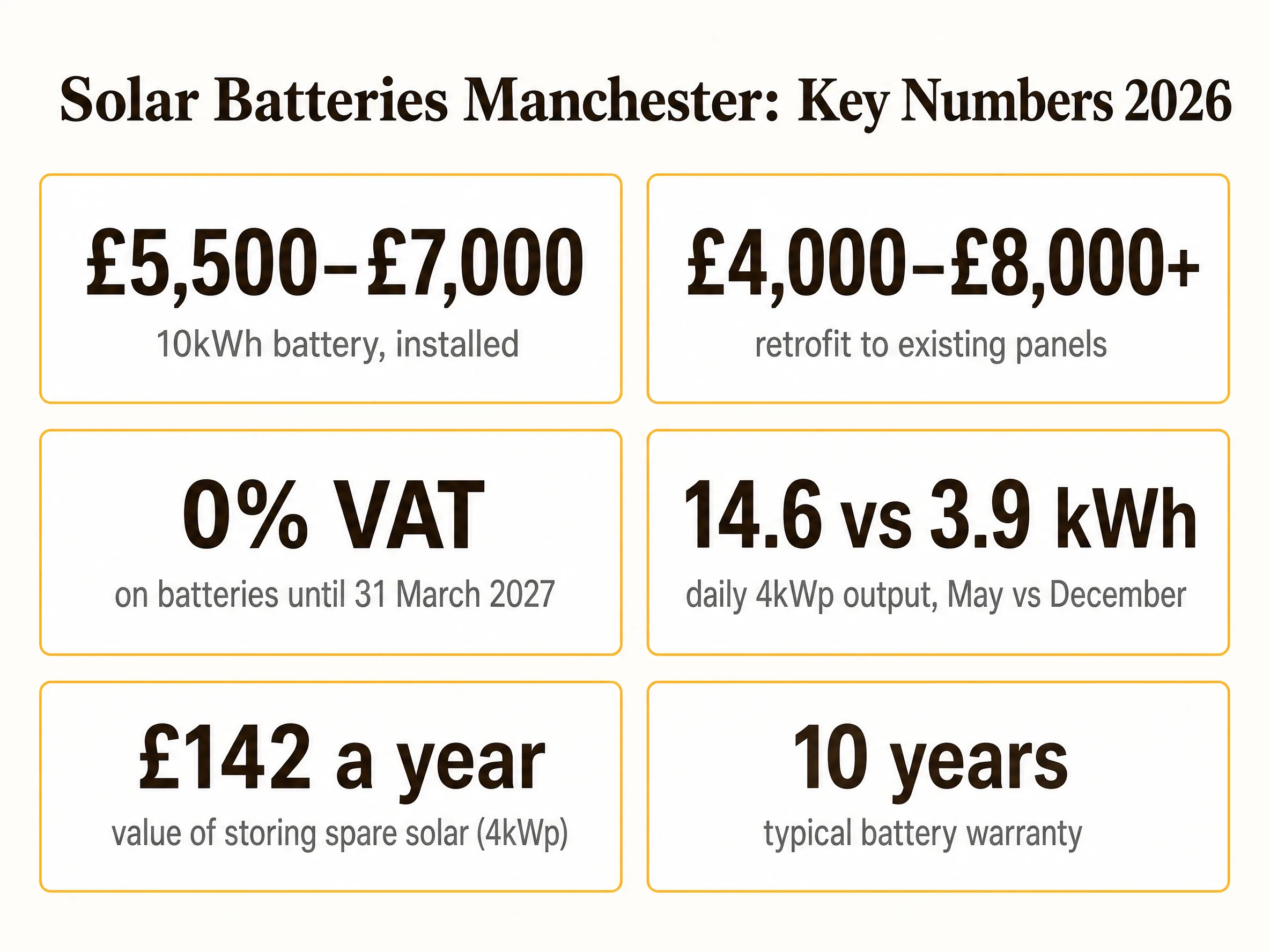
- Installed prices run from £4,000–£5,500 for under 6kWh to £5,500–£7,000 for 10kWh, and £7,000–£8,000+ for 13.5kWh.
- Adding a battery to existing panels typically costs £4,000–£8,000+, depending on inverter compatibility.
- Batteries get 0% VAT until 31 March 2027, then 5%.
- A 4kWp system in Manchester makes about 14.6 kWh a day in May but only 3.9 kWh a day in December (PVGIS), so there's little spare solar to store in winter.
- Shifting 30% more of a 4kWp system's output from export (13p) to home use (26.32p) is worth about £142 a year in Manchester.
- Time-of-use tariffs change the sums: Octopus Flux pays up to 29.32p/kWh for export between 4pm and 7pm.
How much does solar battery storage cost in Manchester?
Most home batteries cost £4,000–£8,000 installed. Heatable puts batteries under 6kWh at £4,000–£5,500, 10kWh at £5,500–£7,000 and 13.5kWh at £7,000–£8,000 or more. Buying solar and a battery together usually costs £10,000–£14,000 or more.
| Battery | Capacity | Supply | Installation | Per kWh |
|---|---|---|---|---|
| Tesla Powerwall 3 | 13.5 kWh | £5,600 | £1,750 | £414 |
| GivEnergy AIO | 13.5 kWh | £5,200 | £1,600 | £385 |
| Alpha ESS G3 | 10.1 kWh | £2,550 | £1,400 | £255 |
| Solax Triple Power | 5.8 kWh | £2,100 | £1,400 | £362 |
Prices come from Heatable (June 2026) and include 0% VAT. Manchester MCS records show solar plus a 10kWh battery averaging £12,629; see our solar panel cost guide for panel-only prices.
How much does a battery save with solar in Manchester?
On solar alone, less than most people expect. Without a battery, a typical home uses about half its solar output and exports the rest. A battery might lift that to around 80% by storing the midday surplus for the evening.
For a 4kWp system in Manchester making 3,552 kWh a year, that shifts about 1,066 kWh from export at around 13p to home use at the 26.32p/kWh price cap rate. The gain is roughly £142 a year, which on its own would take decades to repay a £5,500–£7,000 battery.
That's why batteries are really a tariff decision. The numbers improve a lot when you charge cheaply overnight and use or export that power at peak times.
Why does winter matter for solar batteries in Manchester?
Because Manchester's winter solar output is small. Our PVGIS modelling for a 4kWp system shows about 14.6 kWh a day in May and 14.2 kWh in June, but only 3.9 kWh a day in December and 3.6 kWh in January. From November to February there's rarely any surplus to store.
A battery that relies on solar alone sits half-empty for four months of the year. Paired with a time-of-use tariff, it can charge from the grid overnight all winter instead. Compare your borough's monthly figures on its page, for example solar panels in Wigan or solar panels in Oldham.
Which tariffs make a solar battery pay off?
Tariffs that pay well for peak export or charge little overnight. Octopus Flux pays up to 29.32p/kWh for export between 4pm and 7pm, so a battery can charge cheaply and sell at the peak. Intelligent Octopus Go's 8p/kWh smart-charging rate is designed for EV owners, so check the terms before counting on it for a battery-only home.
Export rates vary widely. The average household earned 13p/kWh in 2024–25, while Octopus's basic SEG tariff pays 4.1p/kWh. Test different rates in the solar payback calculator.
What size solar battery do you need?
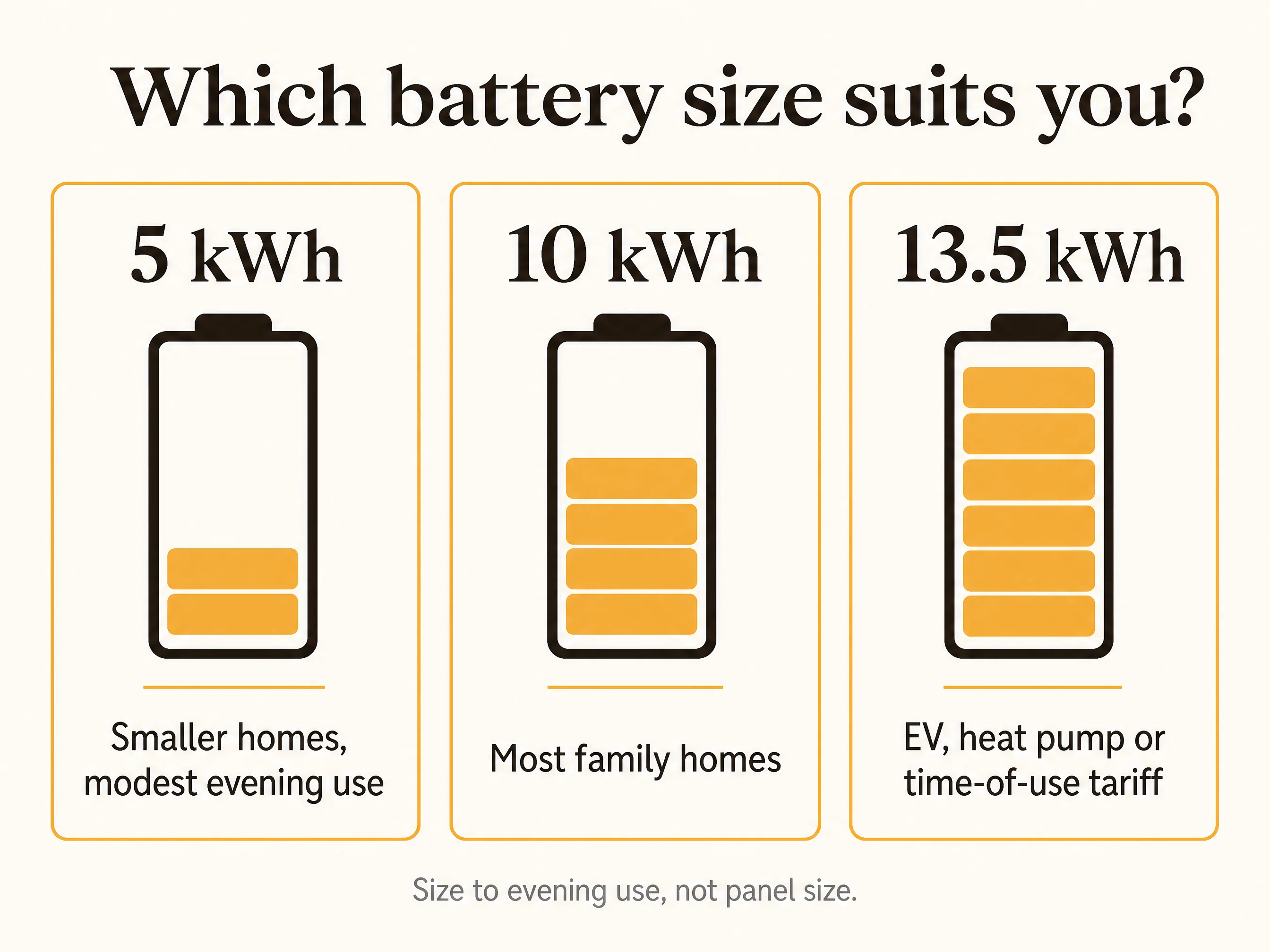
Size it to your evening use, not your panel size. Most homes are well served by 5–10kWh. A larger battery mainly makes sense if you have an EV or a heat pump, or plan to run on a time-of-use tariff all year.
Warranties matter as much as capacity. Most batteries come with 10-year warranties (Tesla, Alpha ESS, GivEnergy), while some cheaper models offer only 5 years (Solax, Fox).
Can you add a battery to existing solar panels?
Yes. AC-coupled batteries work alongside most existing inverters, and retrofits typically cost £4,000–£8,000+. If your inverter is near the end of its life, swapping it for a hybrid inverter with a battery can be the cheaper route overall.
Many Greater Manchester systems went in during the Feed-in Tariff years, so their inverters are due for replacement. Retrofitting also benefits from 0% VAT until 31 March 2027. Check whether you qualify for help in our solar grants guide, or ask for a battery quote.
Thinking about a battery?
Check the numbers for your home and tariff before you buy.
Solar battery storage: FAQs
How much does a solar battery cost in the UK in 2026?
Typically £4,000–£5,500 for under 6kWh, £5,500–£7,000 for 10kWh, and £7,000–£8,000 or more for 13.5kWh, installed with 0% VAT.
Is a solar battery worth it in Manchester?
On solar alone it adds only about £140 a year for a 4kWp system. It becomes worthwhile when paired with a time-of-use or peak-export tariff, or with an EV or heat pump.
Do solar batteries work in winter?
They work, but in Manchester a 4kWp system makes only about 3.9 kWh a day in December, so there's little spare solar to store. Charging from the grid overnight on a cheap tariff keeps a battery useful in winter.
Can I add a battery to my existing solar panels?
Yes. AC-coupled batteries work with most existing inverters, and retrofits typically cost £4,000–£8,000 or more.
What size battery do I need for a 4kWp solar system?
Most homes with 4kWp of solar are well served by 5–10kWh. Size it to your evening use rather than your panel size.
Is there VAT on home batteries?
No. Qualifying residential battery installations are zero-rated for VAT until 31 March 2027, then 5%.
How long do solar batteries last?
Most come with a 10-year warranty (Tesla, Alpha ESS, GivEnergy), and some cheaper models have 5-year warranties.
Methodology
Sources
- Heatable: home battery storage costs (updated 9 Jun 2026)
- Sunsave: solar panels in Manchester (updated 27 Jul 2026)
- EU JRC PVGIS v5.2
- Ofgem price cap, 1 Oct – 31 Dec 2026
- Sunsave: best SEG rates, all tariffs ranked (updated 16 Sep 2026)
- Octopus Energy: export tariffs
- Octopus Energy: Intelligent Octopus Go