Are North Facing Solar Panels Worth It? Real Output for Every Roof Direction in Manchester
Key takeaways
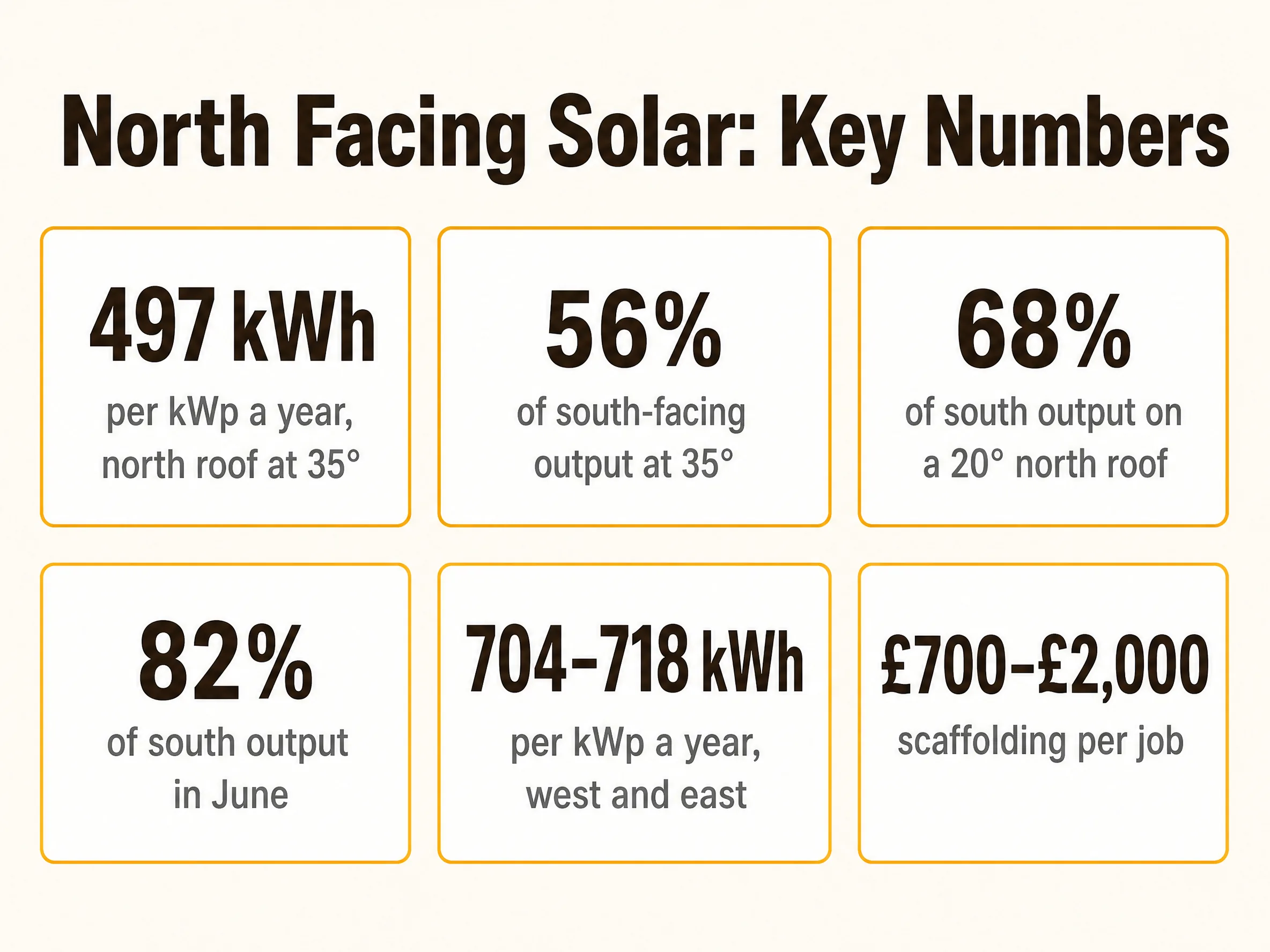
- On a 35° roof in Manchester, 1kWp produces about 886 kWh a year facing south, 718 east, 704 west and 497 north (PVGIS).
- Pitch matters most on north roofs: at 20° a north roof makes 602 kWh per kWp, 68% of a south roof.
- North panels are a summer asset: in June they make 82% of a south array's output, but only 21% in December.
- East–west roofs lose only about 20% against south and spread generation across the morning and evening.
- Scaffolding costs £700–£2,000 per job, so adding extra panels while it's up is far cheaper than a separate install.
- Adding 2kWp of north panels for about £1,500 while scaffolding is up would pay back in roughly 7–8 years on our assumptions.
Do north facing solar panels work in the UK?
Yes, they generate electricity, just less of it. Solar panels respond to daylight, not direct sun alone, and in summer the sun rises in the north-east and sets in the north-west, so a north roof gets useful light early and late in the day.
The question isn't whether they work but whether the extra output justifies the extra cost. For many homes it now does, because panel prices have fallen while scaffolding and labour haven't.
How much do solar panels produce on each roof direction in Manchester?
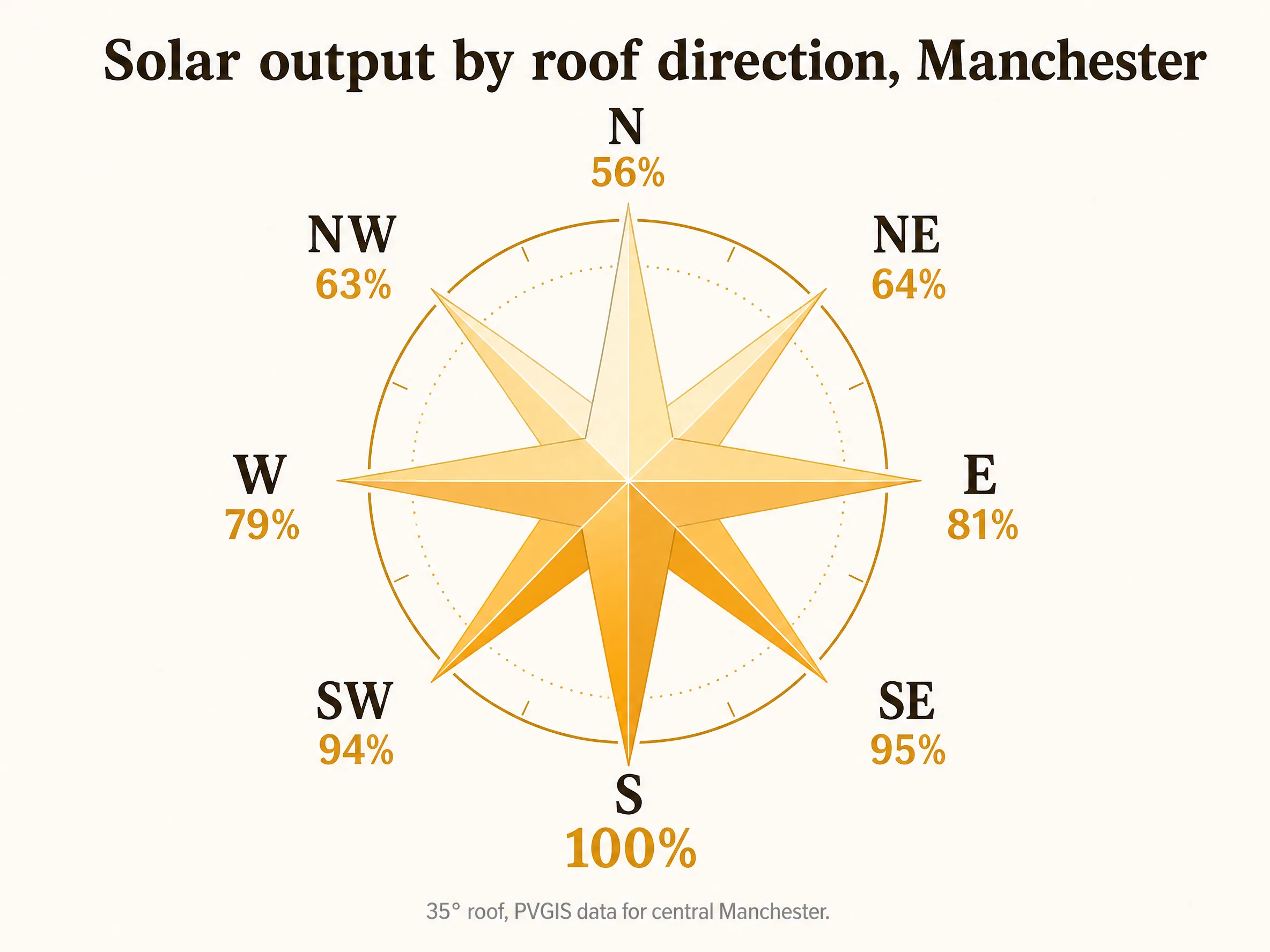
We modelled 1kWp of panels in central Manchester with PVGIS (14% system losses) at three common roof pitches:
| Roof faces | 20° pitch | 35° pitch | 45° pitch | % of south (35°) |
|---|---|---|---|---|
| South | 853 | 886 | 885 | 100% |
| South-east | 822 | 842 | 834 | 95% |
| South-west | 815 | 831 | 822 | 94% |
| East | 738 | 718 | 693 | 81% |
| West | 729 | 704 | 677 | 79% |
| North-east | 643 | 569 | 521 | 64% |
| North-west | 637 | 561 | 513 | 63% |
| North | 602 | 497 | 428 | 56% |
A flat roof with panels laid flat makes about 746 kWh per kWp, 84% of a south roof. Compare your borough's south-facing yield on the Greater Manchester borough comparison.
Why does roof pitch matter so much for north facing panels?
Because a steep north roof points the panels away from the sun. On a south roof, pitch hardly matters between 35° and 45°. On a north roof, going from 45° to 20° lifts output from 428 to 602 kWh per kWp, a 41% gain.
Many Greater Manchester terraces and semis have pitches around 35°–40°, where north panels make just over half a south array's output. Shallow-pitched roofs, extensions and garages are the best north-facing candidates.
When do north facing panels generate most?
In summer, and in the evening. Our monthly PVGIS figures for a 35° roof show a north array making 89.7 kWh per kWp in June, 82% of a south array's 108.8 kWh. In December it makes just 6.0 kWh, 21% of south.
Reddit's r/SolarUK has examples of north arrays out-producing south ones at 7–8pm in summer, when the sun is in the north-west. That evening output is valuable because it's when households use the most power, which also reduces how big a battery needs to be.
Are east–west solar panels better than south facing?
Not for total output: an east or west roof makes about 80% of a south roof in Manchester. But east–west systems spread generation from early morning to evening, so more of it gets used in the home rather than exported cheaply.
If you're home during the day or have no battery, an east–west split can match a south array on real savings. Test different self-use percentages in the solar payback calculator.
Is it worth adding north facing panels to a solar install?
Often, if you're already paying for scaffolding. Scaffolding typically costs £700–£2,000 and is needed whether you fit 8 panels or 20. Adding panels to another roof face at the same time mainly costs the extra panels, mounting and a little more labour.
As an illustration, suppose adding 2kWp of north panels to a job costs about £1,500. At 497 kWh per kWp that's about 994 kWh a year; valued at a blend of 26.32p self-use and 13p export, it's worth around £195 a year, a payback of about 7–8 years. A standalone north-only system at the full £1,700 per kWp would take around 17 years.
Get the installer to quote the extra panels as a separate line so you can see the true marginal cost. Check the total against our solar panel cost benchmarks.
What else should you check before putting panels on a north roof?
Three things. First, the inverter: north panels need their own string or MPPT input, or microinverters/optimisers, so they don't drag down the south array. Second, the grid connection: more panels can push you over the 3.68kW single-phase limit for a simple G98 notification into a G99 application, which takes longer.
Third, shading from chimneys and neighbouring buildings, which hurts more when light levels are already lower. For local yields and grants, see your borough page, for example solar panels in Stockport, or ask for a quote that covers every roof face.
Got more than one roof face?
Ask for a quote that prices each face separately so you can see what extra panels really cost.
North facing solar panels: FAQs
Do solar panels work on a north facing roof?
Yes. In Manchester, a north roof at 35° produces about 497 kWh per kWp a year, 56% of a south roof, rising to 68% on a 20° pitch.
Are north facing solar panels worth it?
Usually when added to a system that's already being installed, because scaffolding is the big fixed cost. A north-only system on a steep roof is harder to justify.
How much less do east or west facing solar panels produce?
About 20% less than south in Manchester: 718 kWh per kWp facing east and 704 facing west at 35°, against 886 facing south.
What is the best roof pitch for north facing solar panels?
The shallower the better. At 20° a north roof in Manchester makes 602 kWh per kWp, against 428 at 45°.
Do north facing panels generate in winter?
Very little. In December a north array at 35° makes about 21% of what a south array does. Most of its output comes from April to September.
Can I mix north and south facing panels on one inverter?
Only if they're on separate strings or MPPT inputs, or use microinverters or optimisers. Otherwise the weaker north string reduces the south array's output.
Do solar panels on a flat roof work?
Yes. Laid flat in Manchester they make about 746 kWh per kWp, 84% of a south roof, and can be tilted on frames for more.